Columbia Street Park had an asphalt basketball court encircled by grass and dirt. I visited the park several times to play pickup basketball games. It was a place where a scrawny Scotch-Irish West Quincy quarry rat could get knocked around by sophisticated South Quincy wayos who were shaving by the time they entered junior high school. Their basketball skills may have been poor, but they could block and tackle effectively. On this basketball court, Paul may have honed his football skills.
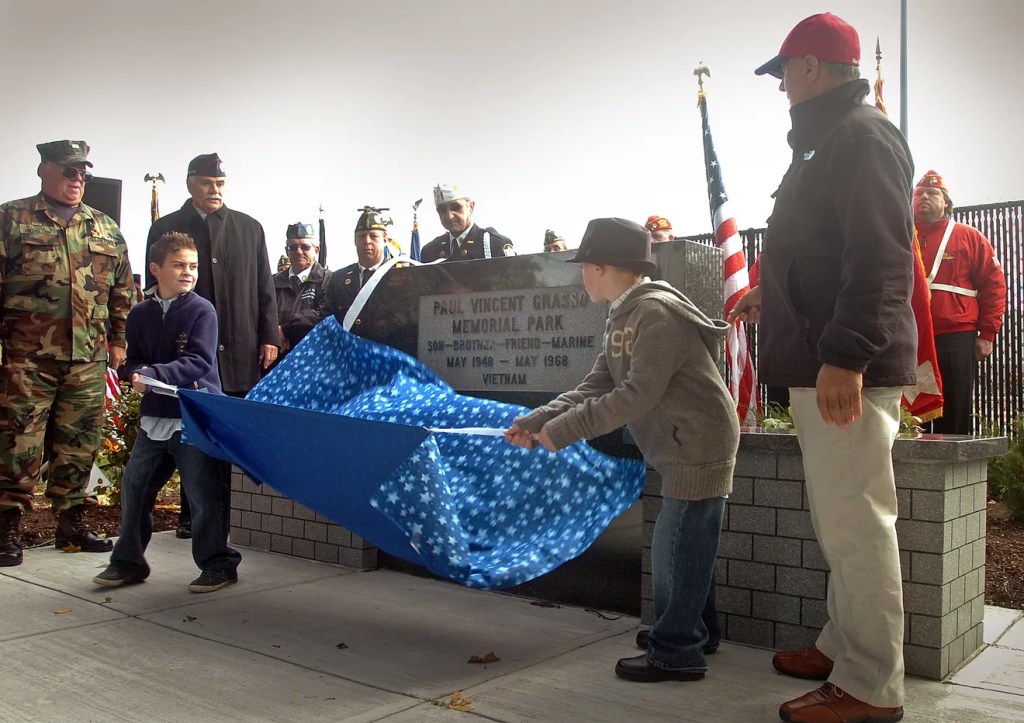
In 1971, the Columbia Street Park was renamed the Lance Corporal Paul Grasso Park. Paul Grasso graduated from Quincy High School in 1966. I did not know Paul. I knew of him; my sister was a grade behind him and would mention his name from time to time. (South/Sterling Jr. High and Quincy High School) Paul played for the QHS Presidents football team. He was a scrappy unsung player. And while attending QHS football games at Veteran Memorial Stadium, I would hear his name over the loudspeaker.
Columbia Street Park was in a section of South Quincy surrounded by generations of Italian granite workers, quarrymen, and stonecutters who had immigrated to the United States in search of a better life. They were a hardworking lot; some stayed in the stone industry, while others moved from the declining granite sector to other forms of employment. Whether it was Fore River Shipyard, Raytheon, Old Colony, or All White Potatoes, others entered the trades. It was a proud community where everybody knew everybody.
Many in the neighborhood were grateful for the opportunities their parents and grandparents received upon arriving at Ellis Island. A community laden with veterans of both World Wars and Korea. A community emboldened with patriotism that ensured if your country called you, you answered. Paul Grasso answered that call; in September 1967, he showed up at Parris Island, South Carolina, for basic training in the U.S. Marine Corps.
Paul graduated boot camp on November 13, 1967 continued training in preparation for assignment as an Infantry Rifleman. Paul arrived in Vietnam around March 1, 1968, as a replacement rifleman assigned to I Company, 3rd Battalion, 3rd Marines, 3rd Marine Division in Quảng Trị Province, South Vietnam, in Gio Linh subsector just south of the DMZ.
Located on the northeast corner of Leatherneck Square, his unit was part of Operation KENTUCKY; their specific orders were to conduct night and daylight ambushes to search and destroy the North Vietnamese Army.
Paul arrived in Vietnam and, within days, met and bonded with another Massachusetts guy, Ed Kochanowski. Kochanowski grew up in working-class South Boston, born to European refugees who fled the aftermath of World War II; Ed’s road out of Southie was to join the Marines. At 16, after getting his parents to sign a waiver, Ed enlisted in the U.S. Marine Corps. Two teenagers from opposite sides of Dorchester Bay formed a friendship in the swamps of Vietnam.
By the time Paul Grasso arrived in Vietnam, Kochanowski was already operating with India Company, 3/3 Marines. Kochanowski helped Paul Grasso navigate the intricacies of the Vietnam War along the DMZ. Their camaraderie lasted two months, ending tragically on a streambed three miles southwest of Gio Linh.
On their May 4, 1968 morning patrol, Kochanowski was assigned to carrying a heavy mortar pack. While fording a stream, the mortar pack’s shoulder strap snapped, throwing him off balance. He lost his footing, slipped backward, and struggled to stay standing. Kochanowski was partially submerged in the water, and the heavy mud was unable to climb a steep riverbank. Seeing his fellow Marine in trouble, Paul Grasso positioned himself above Kochanowski on the stream’s bank. At 6:50 AM on May 4, 1968, twenty days short of his 20th birthday, LCPL Paul V. Grasso extended his M16 rifle to hoist Ed out of the stream. When Kochanowski grabbed the weapon, it discharged a single round into Grasso’s chest, killing him.
The Grasso family was informed that Paul had died in a non-combat weapon accident, but they were unaware of the exact details of his final moments. For over half a century, they were shielded from the complete truth about the incident. Ed Kochanowski was not court-martialed or legally blamed by the Marine Corps, but the survivor’s guilt he experienced over the decades nearly destroyed his life.
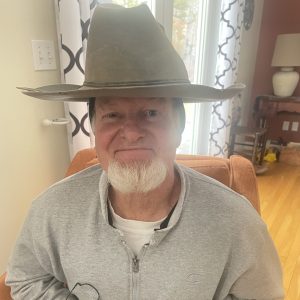
The mystery surrounding Paul’s death finally came to light in late 2025 when Ed Kochanowski recognized the name Grasso on a vehicle registration at a North Quincy auto body shop. The vehicle belonged to Paul’s brother, Ray Grasso. Ed located Ray and approached him, declaring, “It was me. I’m the one.” Ray embraced him, explaining that his 57-year search for the missing piece of information about Paul’s death had just ended. Ray felt relief, not anger. Ed felt relief, not guilt, revealing a 57-year secret.